NEIL COWMEADOW - THE EXPERT GUITAR TEACHER IN TELFORD. GUITAR TEACHER AND AUTHOR. GUITAR LESSONS THAT WORK! DEDICATED TO TEACHING SINCE 1999 - ACCELERATED LEARNING TECHNIQUES: LEARN FASTER, PLAY BETTER, AND UNDERSTAND...

  • Home
  • Tuition
    • About Lessons
  • Bookings
  • Guitar Repairs
    • About Guitar Repairs & Technical Service
  • FAQs
  • Testimonials
  • Contact & Location
  • Blog
  • Recommended Products
  • Product
  • Home
  • Tuition
    • About Lessons
  • Bookings
  • Guitar Repairs
    • About Guitar Repairs & Technical Service
  • FAQs
  • Testimonials
  • Contact & Location
  • Blog
  • Recommended Products
  • Product

The Thursday Thesis
Thoughts and Lessons from Life & Guitar Teaching

Episode 133 - Going Dotty

10/1/2019

0 Comments

 
Picture
The Thursday Thesis – 10/1/2019

Looking back, we can usually see the steps that got us to where we are now – the lucky breaks and the mis-steps, the moments where we fluked a win out of our own incompetence or watched our best-laid plans crumble for no apparent reason.

That’s life – everyday is like falling backwards into the unknown, with our pasts streaming out in front of us. We can’t see where we are going, only where we have been.

As Apple CEO Steve Jobs famously put it: “You can't connect the dots looking forward; you can only connect them looking backwards, so you have to trust that the dots will somehow connect in your future. You have to trust in something - your gut, destiny, life, karma, whatever. This approach has never let me down, and it has made all the difference in my life.”

Wherever we are in life, looking back at our own dots can be helpful. We can ask ourselves what went right, what we could have done differently or better. In so doing we might gain the insight to re-orientate our backsides as we fall backwards into the next year or two, or ten.

We’re falling backwards into the future, and all we can do is move our ass and join the dots.

© Neil Cowmeadow 2019
Please Like and Share The Thursday Thesis with your friends, family, and your invisible supernatural friend. I’d love to hear your comments, along with any ideas you’d care to hurl at me.
[email protected]

0 Comments

Episode 132 - The Perils of Positivity

3/1/2019

0 Comments

 
Picture
The Thursday Thesis – 3/1/2019

Well, well, well...

Having successfully “bah, humbugged” my way through the Christmas period, retreated into the cave and quietly read an intriguing book whilst the rest of the world got drunk and let off fireworks for hours on end last night; then being dragged out of the house at stupid-o’clock this morning by a couple of my friends who think that running around in the cold is a great way to start the year – frankly, it’s a joy to be back at my keyboard.

The Christmas break is always deeply unpleasant, as the well-oiled wheels of life have the sticks of social expectations poked between their spokes.

Anyway, as a slid in the mud and turned my left ankle over this morning it struck me that I should pay a bit more attention to the negative occurrences of life. I mean, it’s all very well me being insanely optimistic and positive, but what about all that bad stuff that crops up?

Having trained my depressed and moping twenty-something self to “think positive” all those years ago, I’m very good at it now.

Perhaps too good.

Before you howl me down for being “too good” at thinking positive, based on what you read in Episode 108, bear in mind that unconditional positivity and optimism have one drawback – you tend to negate the importance of problems.

There’s a real danger that being unconditionally positive, belligerently happy and generally a pain in the arse could make me miss something, completely - something that I need to know, hidden in that very adversity or problem.

So here’s my New Year’s Resolution: to pay more attention to the adversities, the difficulties and the problems – because tucked away inside every single adversity is a chance to learn, grow, solve a problem or make a change for the better.

I suppose that I’m going to be more positive about negatives.

Adversities are warnings that the chosen path isn’t working; that I’m drifting off-course and need to make a correction.

Inevitably, some will be the products of my own stupidity: that’s a given.

And some will hit me from the blindside on a sleepy Tuesday afternoon, when I’m expecting nothing more dangerous than a small fine for returning my library books late.

However they arrive, this year I’m going to honour the adversity, treat it with more respect and figure out what makes it tick, why it’s showed up in my life and what it’s trying to tell me.

Then I’m going to flip it around, spank its arse and make it my best friend.

Bugger! There I go again – being ridiculously positive towards negatives.
 
 
© Neil Cowmeadow 2019

Please Like and Share The Thursday Thesis with your friends, family, and your domesticated Ravenous Bugblatter Beast of Traal. I’d love to hear your comments, along with any ideas you’d care to hurl at me.

[email protected]


0 Comments

Episode 130 - What Do You Do?

20/12/2018

0 Comments

 
Picture
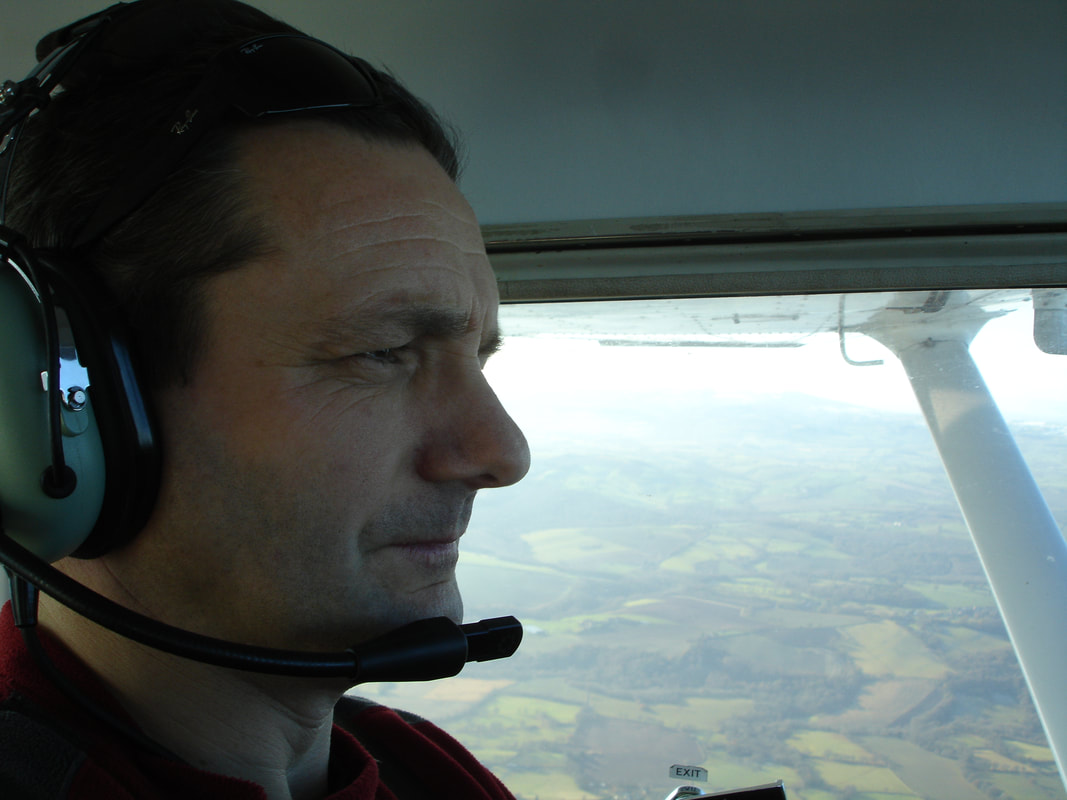
Day One of not having a job - flying a Cessna 155 over my house.
The Thursday Thesis – 20/12/2018

“So, what do you do?”

Once you’ve eased past the Great British obsession with the weather, that’s one of the most common questions you are asked when beginning to make someone’s acquaintance, isn’t it?

Back in Episode 111 I rolled-over the difference between being a guitar teacher and doing the work of teaching guitar, so there’s no need to re-visit the question of identity versus activity: you can find that episode in the blog archives.

No, I’m mulling that question over for another reason, which will inevitably take me down the rabbit-hole of human potential, where The World went wrong and what we can do about it.

You see, last week I was asked what I did...

“Pause, Neil. Pause and think...” I told myself.

That wasn’t going to happen, was it?

After all, I’m stupidly enthusiastic about what I do: just give me a sliver of a chance and I’ll soak with my enthusiasm and emanate passion for teaching guitar. Just ask me about it, I dare you!

That also makes me a general pain in the arse to anyone who wants to be boring.
So I gushed – I couldn’t contain myself!

“I’m glad you asked, Olga, because what I do is unlock the secret code that makes playing the guitar easy, setting my students free from years of frustration and self-doubt, and by giving them the secrets of music they unleash their own creativity, find self expression and develop unstoppable self confidence...”

The lady looked puzzled and asked again, “So, what do you do, really?”

Damn – I’d only paused to snatch a lungful of air before I started on the good bits...

We laughed and pinged back and forth until she (sort-of) got the idea that what I do is hang out with my wonderful friends, laugh, tell jokes, and play guitar – all the while infecting people with insane positivity.

“How long have you been doing that?” She asked.

“Nineteen years, with the last ten being full-time.” I said.

Then it hit me: TEN YEARS!!!!

That’s why today seems like an opportunity to mark that anniversary and remind myself that I’ve been blessed to make my living doing what I love most: helping people to get what they want.

Ten years ago I quit my job in finance, because I didn’t think that the company’s products were something I wanted to be a part of.

My old boss, David, was probably glad to see the back of me, and at the time I was glad to be getting away from him, too. With hindsight, I recognise what a good, honest and diligent man he was. I didn’t see it back then and missing the opportunity to learn from him was a great loss and my mistake.

David thought I could do better with my abilities – and I think we all can. Every single one of us is capable of way more than society thinks we are, whether that’s behind a guitar, singing, in business, relationships, health...every single thing you can think of, you can be better at it than you think.

I reckon that if a washed-up pudding like me can turn themselves around, anybody can.

It takes effort, but we can all do, be and have more of what we want. Most people won’t try, because they’ve been told not to be “too ambitious / driven / weird / selfish / rich / successful /etc, etc, etc.”, they’ve been told to fit in.

For the last ten years I’ve put in more time and effort than most people would consider sane, worked 90-plus hour weeks and earned a First, written a couple of books, a lot of songs, and a ton of other cool stuff.

Maybe I’ve been lucky – maybe I’ve just worked really hard.

But here’s the thing: I haven’t done a day’s work in ten years, because my work is my favourite game.

Every day I get to follow my natural inclination to teach what I love and to help people see themselves better, to rekindle the vital spark of humanity and creativity, fun and joy that school, university and the world of work bullies into submission, causing the spark to die down to acceptable, manageable levels.

But the spark never goes completely out. It flares when we sing in the car, dance in the kitchen, marvel at a sunrise or cradle our firstborn.

In those moments we remember what we were before we learned to turn down that flame until it dimmed to almost nothing...

My friend, fight, every single day to keep that spark alive. Guard it, nurture it and feed it, then fan it into flames, then make it grow into an inferno.

That spark is the essence of who you are when nobody is around to make you fearful, to make you need to fit in, submit or conform.

I ask you, “Why do you work so hard to fit in, when you were born to stand out?”


© Neil Cowmeadow 2018
Please Like and Share The Thursday Thesis with your friends, family, and your domesticated Ravenous Bugblatter Beast of Traal. I’d love to hear your comments, along with any ideas you’d care to hurl at me.
[email protected]


0 Comments

Episode 129 - Get Busy Living

13/12/2018

0 Comments

 
Picture
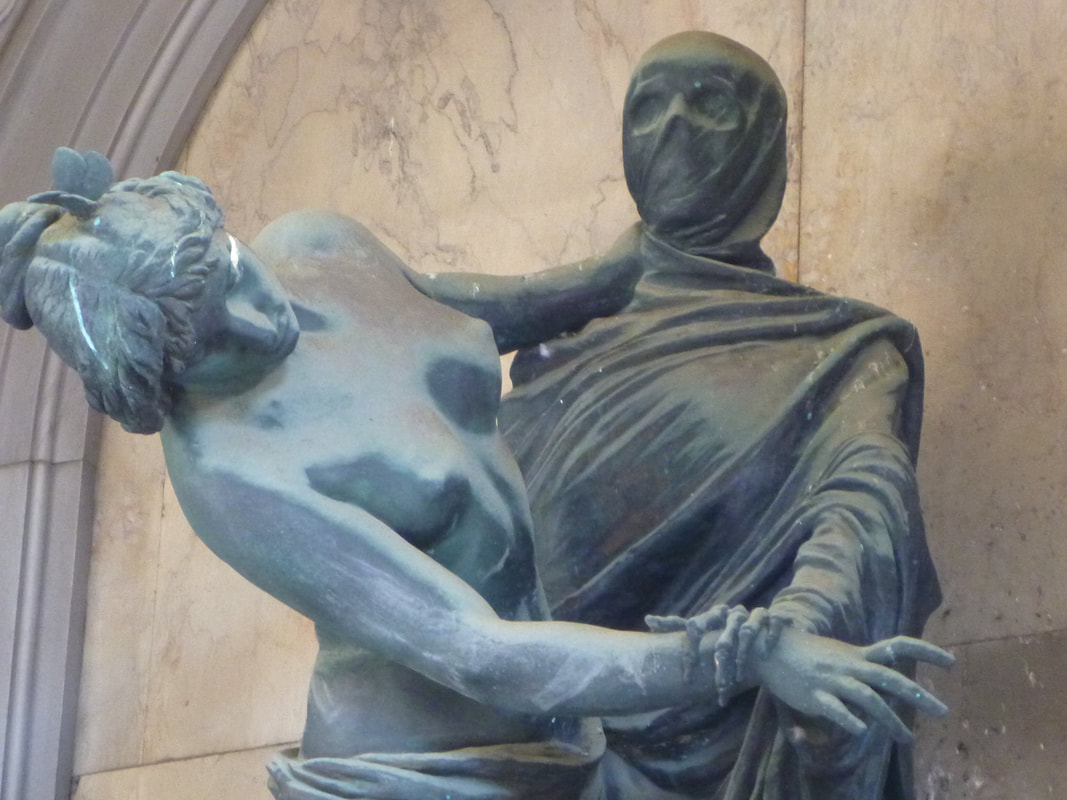
Valente Celle Tomb, 1893, Staglieno, Genoa, Italy
The Thursday Thesis – 13/12/2018

If you’re lucky, Death will tap you on the shoulder and cough politely.

If you are luckier still, you’ll notice the tap, hear the cough, and heed the impending call – because Death is coming to usher you and I into the next world...but not just yet.

Maybe the tap you get is a serious illness, a near-miss as you try to text mobile while driving or get so mindlessly drunk at the works do that you nearly choke on your own vomit or decide to go skinny-dipping in a swollen, icy river with the hottie from accounts.

No matter: Death coughs politely, reminding us of his presence.

“Just letting you know...” he whispers.

Fact is, Death is always with us – every waking moment of our short and squandering lives – patiently waiting for the ordained moment to scoop us up into the folds of his midnight-purpled cloak and enfold us in darkness.

It’s not personal: he’s Death, and he’s just doing his job.

We’re going to die: so what?

Well, this is what:  it’s something I’ve ached to get off my chest for a long time, and with Christmas looming and everybody being all jolly-bollocks about it, I feel the need to point out to a tiny minority that if you are not yet dead then you are a million miles ahead of the curve – and you should be grateful for this day – this sacred, ineffable gift – that has been bestowed upon you.

Whether you think that life is nothing more than the playing-out of cosmic permutations, evolution, or an ongoing experiment conducted by interfering space aliens; it doesn’t matter a damn, because today you are not dead, and there is still hope.

Today you are not dead, so there is another golden chance to write the next chapter in the story of your life, a chance to forgive and to atone, to love and redeem.

Death ushers us into oblivion, where all is changeless and still; where our regrets endure forever and the last chance has gone wherever last chances go to when they are gone...

Death is the longest, lazy-arsedest lie-in you’ll ever have.

So, my dear friends, when you wake up tomorrow and find yourself gloriously, rambunctiously alive – reborn after the little death of sleep – or when Death taps you on the shoulder and immediately realises there has been an administrational error at head office...thank your lucky stars for that simple first observation of the day; that you are not yet dead, that the man with the scythe wasn’t looking for you after all, that no matter how crappy your bored, frustrated, skint and lonely life is, you are among the blessed.

Get busy living, because we are already dying – you and I, man woman and child. If waking up isn’t the finest thing that happens to you today, then you’ve missed the whole bloody point of it all.

If you wake up and want to cower beneath the duvet because your life is so shit, that’s Death, tapping you on the shoulder and whispering in your ear “Do something else, because your time is running out, my friend. Do something else, and I’ll be back soon enough...”

Get off your arse and do something – preferably something that makes you happy, makes you uncomfortable, and makes you feel alive!

Don’t lie there whimpering because it’s Monday and you have to go to the job you hate – I’ve done that, and it sucks.

Do something about it. However painful or inconvenient it might be, will it be worse than proving – yet again - that the way things are makes you miserable?

And if (like me) you’ve ever entertained dark thoughts of ending it all, just stop: you’re just a self-indulgent queue-jumper who can’t be arsed to make the effort and live until your turn to die comes around.

You’re dying, I’m dying; Man, woman and child. How shall we live before we shuffle to the front of Death’s queue?

That’s the great unanswered question, isn’t it?

© Neil Cowmeadow 2018
Please Like and Share The Thursday Thesis with your friends, family, and your Ravenous Bugblatter Beast of Traal. I’d love to hear your comments, along with any ideas you’d care to hurl at me.
[email protected]


0 Comments

Episode 123 - Ones and Twos and Threes

2/11/2018

0 Comments

 
Picture
The Thursday Thesis – 1/11/2018


Last episode you read about the difference between zero and one - the biggest difference you can imagine: the difference between nothing and something.

You may recall that going from zero to one is absolute, but going from 1 to any other number is just a difference of quantity.

I know that going from zero to one takes balls of steel, whilst going from 1 to 2 to 3 is easier, because you’ve done it before and it will be easier next time.

But following someone else’s pathway to success is altogether less scary.

Ever hear of Conrad, Gordon and Bean?

They’re not a law firm, they’re the crew of Apollo 12, and you’ve never heard of them.

You probably remember the name Neil Armstrong, but who was that other bloke in the Apollo 11 Lunar Module...Buzz something or other...Lightyear?...no...it’s gone...

If you believe that NASA managed to put a man on the moon nearly 50 years ago – something they can’t do today because they have ”...lost the technology” - think of the difference between the first mission (Apollo 11) and the second mission (Apollo 12).

Apollo 11 proved the concept, Apollo 12 merely reiterated it.

Another great first was the Four-Minute Mile and Roger Bannister: once RB proved it was possible, how many more sub 4-minute miles were there that year?

Well, just one actually – John Landy.

“John who?” I hear you ask...

Since Bannister’s breakthrough, hundreds of other runners have clocked a mile in less than four minutes. It’s a great achievement, but they all followed Bannister’s lead.

And that’s my point: whatever you want to do, just have a look around and see if anybody else has already done it. If somebody has already done what you plan to do – get rich, lose weight, write a book – whatever it is, you have a precedent.

Success, as they say, leaves clues.

One of the smartest things you can do is look at someone who is already successful in your area of ambition – a role model or mentor – and once you have found, get busy digging. Find out how they managed to become successful, find out what they did, how they thought, what their beliefs were.
Then steal their best ideas to help you get what you want by taking consistent action that moves you in the direction of your desired outcomes.

There is an abundance of wonders in the world, opportunities are everywhere and there is plenty to go around. The pathways to success criss-cross the world, they are the biographies, books, teachings and wisdom of people who have achieved their own version of success.

Hidden in plain sight, in the multitude of bookshops and libraries, online archives, podcasts and teachings are the pathways to your own success – there, right under your nose.

You don’t have to be the first to be successful.

In fact, there may be a reason why nobody has done it before.

But if you can find anyone who is crushing it in your field, watch and learn; read and understand, listen and assimilate.

Success leaves clues.

© Neil Cowmeadow 2018
Please Like and Share The Thursday Thesis with your friends, family, your cat, unicorn and anyone else. I’d love to hear your comments, along with any ideas you’d care to hurl at me.
[email protected]

0 Comments

Episode 122 - Zeros and Ones

25/10/2018

0 Comments

 
Picture
The Thursday Thesis - 25/10/2018

Two years ago, today, I bought my first investment property – Happy Birthday to me!

As the completion date approached I was edgy and nervous: at that time I was terrified of taking money out of the bank to invest in a house I wasn’t going to live in. Deep down I sorta-kinda knew my limited knowledge of property investing increased my risks, but the stubborn part of me was seeing it through, no matter what.

The truth is that fear had me in its grip and I almost pulled out of the deal at the last moment.

And when the deal was done and my bank balance was emptied, fear rushed in to fill the hole. That fear got a lot of attention from me, so it should have been no surprise that it stayed around, stinking-up my thinking for weeks.

But something had changed: me.

Doing that first property deal moved me from Zero to One; flipped my mindset from “I want to...” to “I do...”

Your first guitar lesson willl be the very worst, ever - you'll never be that bad again, I promise.

And that's because the difference between zero and one is the biggest difference you can imagine.

It’s the difference between nothing and something.

From 1 to any other amount is just a difference of Quantity: zero to one is a difference of Quality - it is a fundamental change of nature.

Going from 1 to 2 to 3 is easy, because you’ve done it before and it will be easier next time.

Going from zero to one takes balls of steel, because it is virgin territory and you’ve never been there before.

The difference between zero and one is absolute: it is the shift from infinite nothingness to finite somethingness.

After that, it’s just a process of refinement.

That’s why Episode 1 is the hardest, why your first child is the toughest, why the first deal is the most fearful.

The first time for anything is usually terrifying – think of the first time you had sex!!

The fear didn’t stop you trying it though, did it?

Armed with the certainty that you were SO not a stud or a total sex-kitten, you still went for it, didn’t you?

And you’re worried about your first poem, book or deal?

If you’re looking to do a business deal, first reconcile yourself to the fact that your first deal will be abysmal, the second one will be a little less bad - just north of Shittsville – and your third deal so-so: the fourth might rise to the dizzy level of OK.

By the time you are 5 or 6 deals in, you’ll know what to do, based on experience and a trail of cock-ups and disasters. You’ll learn faster by doing it than by waiting, learn deeper from experience, and have light-bulb moments and flashes of inspiration along the way.

If you are learning to play guitar, your first chord or riff will be bloody awful, but you are a guitar player from the moment you pick up the guitar and play your first bum-note.

And what’s most important is that you’ve done it, for real. You cannot deny that you are the genuine article, since your first deal is incontrovertible proof. It’s that concrete, that simple – that easy.

The fundamental transition from Zero to One is the greatest possible change: after that, all that changes is the size of the numbers.

So trust me on this: whatever it is you want to do, whatever it is you want to become, learn or begin – begin it.

The first step, the first deal, the first chapter will be dreadful, but it will change you from a Wannabe to a Gonnabe, and the second step, the second deal and the second chapter will be better...

And you will have become the person you wanted to become.
 
Have a Fantastic Day!

0 Comments

Episode 121 - Paying Twice for Everything

18/10/2018

0 Comments

 
Picture
The Thursday Thesis - 18/10/2018


The seminar was about to close and the delegates began to fidget, eager to gather up their folders and bags before heading out on the long drive home.

The speaker had been an absolute barnstormer – boundless energy and charisma from beginning to end: he had everyone fired-up and ready to bench-press the World.

“Remember to drop all your notes and folders in the bin on your way out!” he called, grinning, as we filed out.

I approached the stage and shook hands with him, thanked him for an inspiring experience and asked him what he’d meant by that comment about notebooks and bins.

"It’s kind of a joke, except it isn’t”, he said. “You see, most of the audience will never open their folders or notebooks ever again – they leave, and it’s over. Nothing happens for them because they don’t take action. As good as my stuff is, and as passionate as I am about helping people, most of them will do precisely nothing with what I’ve shared with them today: it’s really sad.”

The two-day finance seminar had been the easy part: the hard part lay ahead of us all.

What I’ve learned over the last two years is this: to really get maximum value from a course you must pay for it twice.

First there’s the easy part – the cash and time investment in the course. Whether you spend a few pounds on a book or tens of thousands to hire the best mentor you can find, there’s an investment of money involved. Then there’s the time – in the course or seminar and travelling to and from it..

Once you’ve paid your “Entry Fee” you have to get busy paying all over again.

And this is the hard part, because this time you are going to have to pay for it with a lot more of your time – the most precious of all your resources.

Within the Personal Development industry there’s a saying that goes “The people who take the courses take ALL the courses”, and there’s a lot of truth in that.

“Course junkies”, as they are known in the trade, stride purposefully from venue to venue rather than take meaningful action in the direction of their dreams.

All too often, Course Junkies delay action until they’ve finished the next course.
Inevitably, once that course is completed, there will be another course that is essential before they unleash themselves...

So, when I next bump into that guy from the ABC course at the XYZ conference, the chances are he’ll grimly tell me he’s no further down the road than he was at ABC, six months previously.
I’ll try not to look surprised.

He’ll doubtless marvel at the work I’ve put in and the small amount of progress I’ve managed in that same six months – possibly he’ll tell me I’m “lucky” that my hard work has paid off.

This “Lucky” business makes my teeth itch with rage, because luck has very little to do with success, as far as I’ve been able to discover from researching successful people, their live stories and business book.

“The harder I work, the luckier I get”, as the old saying goes. In other words, they work hard and prepare for when opportunity shows up. Luck is an opportunity wearing working clothes.

What I’ve noticed about the many courses and seminars I’ve attended, the webinars I’ve sat through, the Expos and Fairs I’ve spent precious time walking around is this: the vast majority of attendees do absolutely nothing as a consequence of taking the course or attending the event.

This is very good news for me, and it’s all a matter of simple math.

Only around 3% of the population voluntarily take part in personal development of any kind. Yep, less than 1 in 20 of the people around you and I will ever set foot in any kind of Personal Development or educational seminar.

And here’s the really amazing part of what I’ve been able to discover: of that tiny minority who actively do any kind of Personal Development training, only around 8% will take meaningful action based upon the course or seminar.

So, 3% show up, and 8% of them execute, which gives me a ball-park figure of 0.0024% of the population investing in themselves and then taking action on what they’ve learned.

That’s also why you and I shouldn’t worry too much about competition – because there’s not much of it around, when you stop to think about it.


© Neil Cowmeadow 2018
Please Like and Share The Thursday Thesis with your friends, family, your cat, unicorn and anyone else. I’d love to hear your comments, along with any ideas you’d care to hurl at me.
[email protected]

0 Comments

Episode 120 - Do High Percentage Stuff

11/10/2018

1 Comment

 
Picture
The Thursday Thesis - 11/10/2018

Every so often I like to find somewhere remote and quiet to just sit and think; to plan the next few months – what to do, when to do it, and make sure I was doing it for the right reasons.

I ask myself one of life’s great questions - which I got from Gary Keller’s book “The One Thing” (link at the bottom of this post), here it is...

What's the ONE Thing you can do such that by doing it everything else will be made easier or unnecessary?

My normal response is to scratch my head, adjust my headphones and make my pen start to move on the paper, brain-dumping all of my current and potential projects onto the page so that I could see them and objectively assess them.

There are easy and fast projects, challenging and slow projects, and overwhelming projects which could take the rest of my life to complete.

But now I have the buggers on paper I can begin to eliminate the low priority/low return projects, along with the ones that did not fit with my Vision of how I want the rest of my life to pan-out.

Last time I did this I found my One Thing – and it’s the same One Thing that I had twelve years ago.

Yep, 12 years on and I still haven’t finished version 1.0 of my project. I have three bulging lever arch files crammed with my notes, but nothing even close to a draft. What an arse!

So I started brain-dumping my key ideas onto my yellow pad, line after line of Deep Magenta ink filling 8 pages of bullet points and sketches. It’s a mess, but the mess is marking the places where the good stuff will go, and the few bits of good stuff are already done.

I am certain that speed is the key in these scenarios: you have to write fast enough to outrun your fear.

Over the next few weeks and months I’ll re-write and fettle those notes, expand those bullets and pay somebody else to draw the pictures so that another human being can make sense of them. I will complete my “Shitty First Draft”, my SFD 01.

Then the fun really starts!

By the time I’ve been through SFD 1 a few times, edited it, stripped out the clunky parts and sharpened things up in SFD 2, SFD 3, and probably SFD 4, it will be tidy, ready for formatting and the day when I finally get out of my own way and hit the big scary button which says “PUBLISH”.

Once that’s done I’ll ask that great question again: “What's the ONE Thing you can do such that by doing it everything else will be made easier or unnecessary?” and burn through another yellow notepad.

Keller reckons that we must focus on, and do, only our high-percentage stuff – the things which matter most.

It’s commonplace for people to spend too long perfecting things which are low-percentage activities and pay the price in lost opportunities.

There’s not enough space on the internet for me to ‘fess-up to all of the low-percentage things I’ve wasted years on;  for now I’ll just mention that I played nothing but “Smoke on the Water” for months when I began to learn to play guitar. That’s low, low, low percentage stuff, but I was just a kid then, and I honestly, sincerely, truly - cub’s honour - NEVER play that riff now.

As a guitar teacher, I always start with the highest-percentage stuff first. If the student gets that in place first, a great deal of what follows will be a smooth progression towards their goals: without it, every week will be tougher than it needs to be, every new skill will be slower and harder to acquire, remaining less secure for longer.

In every field of endeavour there are high-percentage and low-percentage activities. It doesn’t matter if you are young or old, employed in a job, working for yourself, or not working at all – figure out which activity is your most important, the one which – once completed – will make everything else easier or unnecessary.

Deep down, you probably already know what it is already, don’t you?

It’s the elephant in the room for most people; I know it was for me.

When things matter most, we tend to skirt around them, because they’re too big and scary to tackle, despite us knowing that they are vitally important - crucial to our hopes, dreams and goals.

Are you nodding, right now?

If so, you might want to grab a pen and paper and start jotting down all the “stuff” you would like to get around to one day.

Which one of them scares you most?

That’s probably the thing that matters most and which could make the most difference.

I don’t claim to know what your high-percentage stuff is, but you know what it is, don’t you?
 

Here's the link to Gary Keller's book: 

https://amzn.to/2OjzmnR

© Neil Cowmeadow 2018

Please Like and Share The Thursday Thesis with your friends, family, your cat, unicorn and anyone else.
I’d love to hear your comments, along with any ideas and comments you’d care to share with me.


[email protected]

1 Comment

Episode 119 - More Horses?

4/10/2018

1 Comment

 
Picture
The Thursday Thesis - 4/10/2018

My friend gushed about her upcoming podcast, about how awesome it was going to be, how good her guests were going to be, how crisp and clean her audio was going to be, and  once she’d got that nailed-down...

Spot the pattern?

This lovely lady didn’t need a better microphone, she didn’t need a new recorder, the very best guest, just to get things started with a bang: she needed to let the handbrake off and start moving.

I see this all the time – people are afraid to start doing their Epic Shit because they:
  • Don’t know how
  • Haven’t finished the course
  • Don’t have a degree
  • Have no experience
  • Are too old, too young; too black, too brown, too  white; a bit too male, female etc etc etc

Sometimes they’re just plain scared.

I see those people, because I’m one of them!

And all the time, we are feeling worse because we see people who are not as good, bright, insightful or talented as us making progress. How dare they do that – they’re nowhere near as good as we are, and we’ll show them, just as soon as...

It’s like we’re sitting at the traffic lights of life in a hot car, maybe it’s a Lambo or a Ferrari, the engine is purring, eager to respond to the slightest twitch of our right foot. In our mirrors we see a little old man on a clapped-out, 50-year old Honda Super Cub moped slowing down to wait for the light, too.
No problem, we’ll leave him eating our dust, won’t we?

When the lights change we dump the clutch and stall the car, having forgotten to release the handbrake. We watch in disbelief as that clapped-out Honda lurches past us and pootles off down the road.

And did we hear somebody shout “wanker!” as they passed our window?

This is the moment when we decide that a Bigger Engine is the answer. Our Bigger Engine might be a higher dergree, a course, an internship or a mentoring program – all of which will give us more knowledge and thus, more power to apply to our sticking-points. We're convinced that we need that extra horsepower before we can move an inch.

But more horses - more courses, more degrees, better mics and better guests - won’t move you or me a millimetre, unless we release the brakes. Nothing happens until we learn how to take that bloody handbrake off!! Until we do that we’ll remain stuck at the traffic lights in our Lambos -  waiting, waiting...

We have “All the gear, no idea”, as the saying goes.

We are impatiently waiting to be perfect before we begin: wanting to perfect – right out of the box. And as we wait, our Lamborghini slowly rusts around us, the gas-tank runs dry and the engine falls silent.

Whilst waiting to be ready, the clock runs out.
We may die with our song still inside us, our greatest work a prisoner on our hard-drives or trapped in the labyrinth of our minds.

Imperfect action beats waiting to be perfect, every time. Rob Moore says “Start now, get Perfect Later”, and he’s right: I’ve used that phrase for decades: with guitar students, coaching clients and mentees, trainee croupiers and friends.

Do it badly, at first, but do it. I promise you that you’ll never be this bad at it, ever again. It will get better, you will improve.

Start Now.


1 Comment

Episode 118 - What Price Slavery?

29/9/2018

2 Comments

 
Picture
Episode 118 - What Price Slavery?

The Thursday Thesis - 27/09/2018

If someone offered you the chance to buy yourself a job as a slave, to be on-duty 24/7, required to respond to the pettiest of things without delay, to never have a day off or to leave the office; to be tracked, followed and recorded everywhere you went, records kept of everyone you spoke to, and everything you wrote or read, what would you say?

You wouldn’t take that job, would you?

I jumped at the chance, myself – as most people have.

For me, it began with brick-sized Orbitel mobile phone, back in the early 90’s. A couple of years later it was The Internet and the speed of a roaring 14K dial-up connection.

As a relatively early adopter I even thought I was treading boldly into the future!

Over time the technology has improved: faster data speeds, mobile apps, GPS and a host of other gizmos.

Analogue phones have given way to digital networks, second-generation, 3G, 4G, soon we’ll have 5G networks promising better connectivity and coverage, faster speeds and lower cost.

And it’s gradually dawned on me – as it has for others – that I am little more than a slave to my devices. A slave who pays to be enslaved, because every month EE take money from my bank account -  they have written permission from me to do exactly that.

And every time I use my phone or my laptop I provide data to EE, BT, Google, Mozilla, Microsoft and just about everybody else, it seems. My data – and yours – is used to develop algorithms that are supposed to make things better for us.

But here’s the thing: it doesn’t make things better – it makes things worse, because all the harvested data is used to develop insight into us, our thoughts, our beliefs, relationships. Where we go, how we move, and what we say is used to develop better programming for artificial intelligence – AI – that learns and evolves faster than organic life-forms can.

The Big Brother state of Orwell’s 1984 has nothing on the current state of affairs. Orwell’s horrors were the Telescreens, which watched and listened from their place on the walls: ours do it from our pockets and handbags.

Personally, I have a ton of issues with mobile phones, here are a few of them:
  • Distraction by alerts, pings and ringtones
  • Separation anxiety – “OMG, I’ve forgotten my phone!
  • It’s something else to carry around
  • Conversation killer
  • Attention lowering effects
  • Encourages the inability to delay gratification
  • Expectation of immediate response
  • Trivialisation of communication
  • 24/7 tracking – you bought yourself an electronic tag
  • Remote access to camera / microphone – Orwell’s telescreen is in your pocket
  • Microwave radiation next to your brain...not the best idea, ever!
  • Retards driving and texting – what kind of cretin believes a text message is more important than watching where their two-tonne metal box is heading at 60 mile per hour?
  • Remote working means there’s no escape from work – business overheads are now your problem, and you have lost the ability to leave the office at 5pm
  • The ridiculous expectation of immediate response. Grow up!
  • Above all else, remember that EVERYTHING you do is under surveillance.
    • Big Brother is not only watching you, he is listening in to every conversation you have.
    • Security Service computers are analysing your speech patterns and assessing how much of a security risk you might be.
    • Your every text message is analysed and searched for “dangerous” keywords and “suspect” patterns.
    • Your every move is plotted and recorded, 24/7.
    • At any moment, your device’s camera and/or microphone can be remotely switched on without you ever knowing about it.
    • What you search for, buy, or chat about is analysed and checked, so that your next search or purchase can be influenced...
I’m not talking about hackers and criminals doing this – I’m talking about the people who make your devices, your mobile phone network company, national security agencies, elected officials and the non-elected agencies. These are organisations with a naked interest in knowing everything about you and me, and a greater interest in maintaining the population of willing digital slaves, like us.

We slaves pay out masters with our taxes and our monthly direct debits.

We are slaves who worship our masters

Slaves who are anxious when parted from our masters.

Slaves who crave the sound of our masters’ voices.

Slaves who willingly pay to be enslaved.

If you thought that your mobile phone would set you free of the need to be in the office, or would mean you never had to wait in for that special person to call, then I can guarantee you won’t have seen it coming.

So, here’s a challenge – I call it the Freedom Day Challenge - can you go for one day, just 24 hours, without your phone, PC, Mac or tablet?

Any takers?
 

If this got under your skin, made you smile or pissed you right off – hit the like button to Share it with your friends, family, and anyone else.

Email me at [email protected]

 
2 Comments

Episode 117 - The Possibility Matrix

20/9/2018

1 Comment

 
Picture
The Thursday Thesis - 20/09/2018

Every so often we see something in a new way: our perspective imperceptibly shifts, snapping issues and puzzles into pin-sharp focus.

You probably know how it feels, because we all have moments of clarity and revelation: problems evaporate, conflicts ebb, and our way is clear at last.

It’s that sudden “Aha!” moment...when you and I “get it” and know that we can never go back to our old ways – that’s what I’m talking about.

I had one a while ago – a massive, punch-you-in-the-face “Aha!” moment – at a seminar for entrepreneurs.

The speaker was talking about the perennial fear of failure that everyone has. He told us his story of having a great idea for his business but holding back from getting started. He was afraid that it might not be perfect and the business would fail, exposing him as a nincompoop and proving right everyone who had told him he’d never amount to anything.

Perhaps you can relate to that fear?

Despite being a successful serial entrepreneur with multiple businesses which earn him millions of pounds, he is still subject to the fear of failure. He encouraged everyone in the room to take action on the business they wanted to start, on that great idea they’d had. And, as he talked, he drew a little picture that explained something with a clarity and precision that I’d never quite had before.

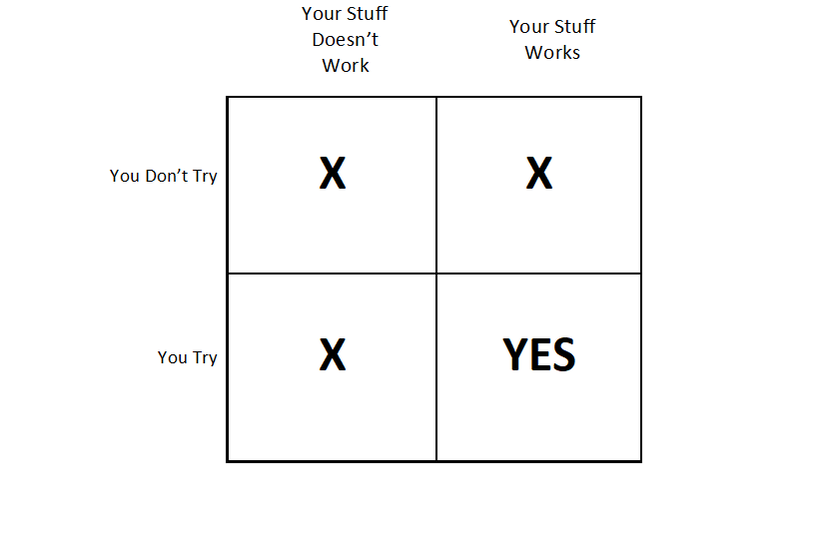
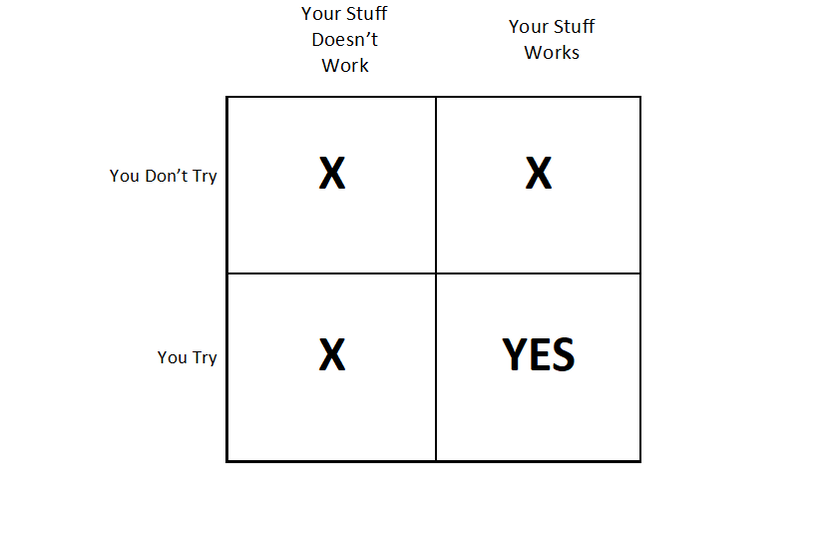
He started with a big square, then divided it into four smaller squares, forming a 2 x 2  matrix. Above the left column he wrote “your stuff doesn’t work”, and above the right “your stuff works” – nice and simple.

Then he wrote next to the top line of the grid “you don’t try”, and next to the bottom line “you try”.

Then he said “if you stay in the top line – where you don’t try – then it make no difference if your stuff works or not, because you will fail by default”.

He drew thick black crosses into the two squares of the top line.

Then he continued, his voice punching the message into my ears “Only in the bottom line can you win. If your stuff doesn’t work at least you know it doesn’t work: you can either improve it and make it work, or you can move onto something else that could work”. He drew a black cross in the bottom left square, paused and said “But if your stuff works, you get a “YES” here in the bottom right square”.
Picture
That was when the penny dropped: only when you try can you have a chance to achieve. The possibility matrix brought it all home with a clarity and force that had me speechless – I “got it” like I’d never “got it” before. I think it was the absolute certainty of the top line that did it; the 100% certainty that if I never tried I couldn’t win. There was no room for doubt in the starkness of that top line: not trying was the very best way to guarantee failure – how had I never seen it so clearly before now?

And that bottom line?

Well, that just looked like a coin toss – heads or tails – and if I called it right I could keep the coin and flip another coin. If I called it wrong I could flip the coin again, over and over, with an infinite number of coins.

But only when you try can you ever do anything. I’m constantly using this idea when teaching guitarists to improvise: often they are afraid of playing a wrong note that they are paralysed into absolute silence – unable to play any notes at all!

They’re stuck in top-line thinking, and my job is to move their thinking into the bottom-line, where there is at least a chance of success.

And I’ve come to understand that that’s what life is all about – giving ourselves a chance to succeed, but that can only occur if we are prepared to try. We must be prepared to risk failure in order to give ourselves a chance of success.
Please Like & Share The Thursday Thesis - it's sure to annoy someone!
1 Comment

Episode 116 - The End of The Story

12/9/2018

1 Comment

 
Picture
The Thursday Thesis  - 13/09/2018

Did you ever see one of those old Road Runner or Bugs Bunny cartoons? You know, the ones where a character flies off a cliff and pauses in the air as the full force of their situation hits them...just before they plummet earthward?

There’s a bemused look of incomprehension that they wear just before there’s a loud “P’tyooooh!!” sound...

That’s how it feels when you’ve finally completed one of your massive goals – one of your life’s great ambitions. You’ll have had a story in your mind of nailing your big thing – of taking the medal or lifting the prize - but you probably won’t have created a story for what you were going to do after you nailed it.

I had that feeling when I finally published my first book “9 Weird Things Guitarists Do - The Common Myths & Misconceptions that Poison Your Playing - and How To Defeat Them” back in 2016.For months I’d written and edited, edited and written, refined and tweaked it until it was as good as I could get it. I’d striven for perfection, but ultimately decided that imperfect and done was better than perfect but never published.

Man, I felt like I’d just bench-pressed the whole damned World when the book went live and began to sell on Amazon. But with the book published and my box ticked, I began to drift; a curious aimlessness set in on me as I failed to begin the next book straight away, in order to sustain my momentum as a writer. Of course, I still had this blog so I could con myself into thinking that I was still being productive, and I began to invest in property at around this time, so I wasn’t being lazy or slacking-off – honest, Guv!

So what happened?

The best way I can make sense of it is that I’d simply ran out of story. I had a plan to write the book and to publish it, and that was great – except it was also what was wrong. My story only took me as far as it went, and as soon as I reached that point everything stopped.

Of course, I should have started to write the next book as I completed 9 Weird Things, and I should have planned to continue with the same daily ritual of writing 500 words per day.

I should have written it, but I didn’t – not for a while.

And – for the record - this world doesn’t deal in shoulda, woulda or coulda, because it’s too busy and too indifferent to listen to you and I making bullshit excuses for our cluelessness pleading to be let off, just this once.

Ditto for completing my first marathon: I ran the course, sauntered over the line and promptly ceased to run for several weeks.

My story got me to the start line and over the 26-and-a-bit miles, but after that – nothing. Zilch, nada, bugger-all, zip, squat.

Now you’d be forgiven for thinking that I’d know better than to let my plan peter out as I crossed the finish line – but that’s what I did.

I’m not an isolated case of stupid, either, because we all run out of story unless we have a plan that extends beyond successfully achieving our goal. Whether you’re getting married, running a marathon or playing a new song on your guitar, you’d better have a story that continues after the event is over. If you don’t have an ongoing story, all you’ll have is a sudden and unpleasant sense of running off a cliff-top and finding that the emptiness beneath you isn’t pushing you up.

“P’tyooooh!!” won’t be far behind.

So ask yourself, as you head off towards your Big Thing – “what are you going to do after you get there?”, because loitering in mid-air is not an option, trust me.

Please Like & Share The Thursday Thesis - it's sure to annoy someone!

1 Comment

Episode 115 - Why Your To Do List is Screwing You Up

6/9/2018

0 Comments

 
Picture
Alchemist's To Do List?
The Thursday Thesis  - 06/09/2018

I am deeply attached to my “To Do” list - after all, we have history together. We’ve been through everything, from getting sober to getting ripped; from getting hitched to coming unstuck – well, we’ve done it all, my list and me.

You may know someone like that: they have a list for everything and everything has its list...

So I’m going to confess to being stupid (again!) and drag a glaring omission out into the light, so that I can remind myself of a great idea that dropped in my lap nearly twenty years ago, but I was too naive and stubborn to pick up and use.

The idea is ever-so-simple, as the best ideas usually are, though their value often slips past us in the first, or even the fifty first, case.

Don’t go straight to your To Do list; instead, start a new list. This is not your To Do list version 2.0 – this is your Who Do list.

This is the list where you write down what you want done, then assign that work or task to someone other than yourself.

So the Who Do list asks you “who can you get to do it?” instead of “how are you going to do it?” and that’s a real game-changer.

Dump everything onto your Who Do list, first – assign the tasks that other people or software can do at least as well as you can (preferably at lower cost, too) and only deal with the jobs and activities that:
a: only you can do
b: are too expensive to farm-out
c: you really love to do

I plan to get really good at this over the next few years – I just wish I’d picked up on it first time around, because I’d now be an expert with a Who Do list, not a overworked muppet with a Dead Sea Scroll of a To Do list.

What tasks are you going to move from your own To Do list and onto your Who Do list?

Let me know if this works for you, vi [email protected]
 
 
0 Comments

8 Hours a Day...

23/8/2018

2 Comments

 
Picture
Episode 113 - 8 Hours a Day...
The Thursday Thesis  - 23/08/2018
 
For as long as I can remember I’ve been interested in sleep.

Sleep fascinates me.

More accurately I’ve been interested in doing without sleep for most of my adult life. As a kid I tried to stay awake all night - night after night – in the hope that I’d be able somehow to forget to sleep once I’d established the habit. I reasoned that if I could eliminate sleep from my routine I’d have more time to read and learn, then I’d eventually know everything and life would be better.

It’s funny what you believe as a kid, isn’t it?

But, to a certain extent I still have the idea in my tiny, pea-sized brain, and I still have a load of unanswered questions about sleep:
  1. Why do we sleep?
  2. Why do we dream?
  3. Why don’t we act-out our dreams?
  4. Why are dreams bizarre and strange?
  5. How do we exercise bladder control when we are asleep?
  6. How does my sleep apnoea affect the quality of my own sleep?
  7. Snoring...?
  8. How does a person’s body-clock affect sleep?
  9. What about naps – do they count as proper sleep?
  10. Can I get paid to sleep? I could turn professional!
  11. Who says we should we sleep for 8 hours every day?

Today I’m just going to stick to question 11 – “Who says we should sleep for 8 hours a day?”

Well, first of all, my mum did.

But I wasn’t going to take it at face value, so for years I experimented with sleep patterns of varying lengths whilst I worked shifts at a busy casino in Birmingham. Some days I’d get a long eight hour-ish sleep, and sometimes I’d only sleep 3 or 4 hours between 14 hour double shifts, bookended by my 20 miles there, twenty miles back cycle ride into the city.

Ever since then I’ve slept only 5 hours a night, and I’m not alone in this – several of my friends are short-sleepers, too. Medicine would probably tell us to try to get 8 hours...

Why 8 Hours?

It seems to have evolved since the 17th century, when street-lamps were installed in Paris, Amsterdam, and London.

With the coming of streetlights, being abroad at night became less dangerous, and mentions of the traditional/natural two-phase sleep pattern began to fade from contemporary literature and documents.

Humans were – until that time – accustomed to a two-part, or “biphasic” sleep pattern, with a “First Sleep” of around four hours, a period of two or three hours of wakefulness, then a “Second Sleep” lasting another four hours or so. This appears to be the natural way we sleep, according to psychiatrist Thomas Wehr.

Wehr observed a group of volunteers subjected to 14 hours per day of darkness. Within a few weeks, the group adopted the two-sleep routine without any prior knowledge of it, suggesting that this pattern is a biological norm when artificial light is absent.

But that’s still eight hours of sleep every day, which seems to be a lot.

Eight hours kip is a third of my life, and I’ve got better things to do with my time than have strange dreams, snore and suspend breathing for long periods of time before violently sucking in air like a man surfacing from a deep lake.

So now I sleep between 3 and 4 hours a night, but take one or two naps of 8-10 minutes each during the day, multiple-sleep pattern is known as “polyphasic sleep”. This means that my total time spent sleeping every day is only 4.5 hours per day, saving me 3.5 hours per day compared to the monophasic 8-hour model.

So, 7 days a week I have an extra 3.5 hours of awake time: that’s 24.5 hours more awake time, every week – an eight-day week!

Is this good?

Maybe... I get a lot done, but there are downsides, too: society isn’t geared-up for oddballs with unconventional sleeping habits, and no sane woman is going to put up with my crazy nocturnal habits.

Now, if I could just eliminate the residual sleep I do need, I’d have time to think up a solution to that problem...

It’s just a thought, but everything begins with a single thought...


© Neil Cowmeadow 2018
Please Like and Share The Thursday Thesis with your friends, family, your cat, unicorn and anyone else. I’d love to hear your comments, along with any ideas you’d care to hurl at me.

[email protected]

2 Comments

Episode 110 - Thoughts Become Things

2/8/2018

2 Comments

 
Picture
William James - The godfather American psychology. An interesting chap, by all accounts...

The Thursday Thesis  - 02/08/2018

William James – the doyenne of 20th Century American psychology – famously remarked that “The greatest discovery of my generation is that a human being can alter his life by altering his attitudes.”

Author and self-help guru Earl Nightingale added that “we become what we think about, most  of the time”.

Both of these things are true – but there is cautionary note to be sounded, perhaps it’s the chime of an alarm bell.

The popular film The Secret even spends 87 screen minutes labouring the point....

But here’s the thing - your dominant thoughts are not necessarily the ones that you are aware of.

There are two levels of thought – the conscious thoughts that you are aware of, and the sub-conscious thoughts which exist just below the threshold of your awareness.

Managing your conscious thoughts and your state is possible, given practice and a structure to build a desired condition or response to circumstances or events.

Your subconscious thoughts are altogether trickier little buggers, though – because you can’t manage what you are not aware of. And since these thoughts are running in the background of your mind at all times, they assert dominance – even over the carefully constructed responses and states held in the conscious mind.

Subconscious thoughts run the machinery of your life – rather like Windows or Mac OS run your computer: everything else runs on top of the operating system, and the operating system is effectively invisible whilst we are busy running our chosen programs.

The good news is that our habitual use of our chosen thought programs will eventually affect and even over-write our subconscious thoughts, upgrading our operating system.
How cool is that?

We can, in effect, programme our own neck-top computer!

And if we don’t run the mental software WE want in our own minds, we will unquestioningly run whatever someone else install in our heads – be it society, media, our peers or our families – regardless of whether those programs help or hurt us.

When you’re watching or listening to the daily torrent of dysfunction, cruelty, misery, hate, fear and pessimism that is the mainstream of modern life, just pause and ask yourself one simple question:
“Is this helping me or is this hurting me?”

You already know the answer, don’t you?

Turn off the TV news, the social media updates, the moronic radio phone-ins and begin , today, to focus on what does good for you instead, what does good for the people you love, the friends you have and the new friends you haven’t yet said “Hello” to.

What takes you forward, fills you with joy and hope?

What one thing, if you began today and did it every day, would transform your life for the better, for ever?

Begin to think about, and then do, that one thing - because everything begins with a single thought...

© Neil Cowmeadow 2018


2 Comments

Episode 109 - No, Yes but, Yes and...

26/7/2018

1 Comment

 
Picture
Episode 109 - No, Yes But, Yes And...

The Thursday Thesis  - 26/07/2018


All I suggested was that we should go out for a coffee, so how did we end up here – flying a hang-glider over the snow-capped mountains, in search of owls?

It must have been something I said, or she said, or both...

Yes, I was on yet another course – learning more interesting “stuff” to add to the rag-bag of other people’s brilliance and the random churning of pig-headedness that pass for my mind – and now that what I learned there has been stirred into the melange and fermented...

I was told to ask my play-buddy out on a first date, and we were instructed by the course leader, Claire, to answer each other with the word “No...” and then our reasons why not.

It didn’t go well: within a few minutes of “no” after “no” I was done. My usual state of boundless, puppy-dog energy was flagging and my self esteem was down around my ankles.

We traded places and revenge was mine!

Frustration reigned and we were both battered by rejection.

Claire gleefully pointed out that hearing someone say “no” to us and our opportunities – especially the incredible prospect of going out on a date with me (she didn’t actually say that a date with me was a great opportunity, but I knew that’s what she meant) – would quickly shut us down and train us to not bother asking again.

Life’s like that: if you keep saying “no” to doing good stuff and life will stop offering you the chance to play.

It got a little better in the next game, when we were invited to play the scenario again, but answer “yes, but...” and give a conditional response.

This was simply annoying.

“Would you like to meet up for coffee and to talk for a while?” She asked.

“Yes, but only if we can meet at a place that serves real Italian coffee.” I said.

“Yes, but Italian coffee makes me woozy, so how about Costa, on New Market Street?”

“Yes, but Costa is a big chain and it’s totally un-authentic” I countered “Can we go somewhere with a more personal vibe?”

Grrr – frustrating!

Every opportunity was accepted, then modified or a condition attached. My play-buddy was annoyed by my evasiveness.

We swapped sides and she immediately began to get on my nerves. I felt like I was trying to nail a blancmange to the ceiling: no matter what I suggested, she always dodged and added a condition.

Claire stepped in before the violence began, suggesting that we try to get a date one more time, but always answer each other with “Yes, and...” and to see what happened.

“Would you like to meet up for coffee and have a chat?” I asked.

“Yes, and perhaps a Panini for lunch, too?”

“Yes, and then we’d probably need – just for research purposes, you understand – a nice pastry
or a very, very small dessert to polish it off. What do you think?”

“Yes, and then perhaps we could take a walk by the river and enjoy the late afternoon sunshine?”

“Yes, and if we’re having fun we could watch the sunset and listen to the owls waking up: I love owls”

“Yes, and...”

I don’t remember exactly how we ended up flying a hang-glider or where the snow-capped mountains were, but we laughed and egged one another on to make the hypothetical date exhilarating and exciting.

That’s what happens when we say “Yes, and...” our brains get all creative and stuff, they begin to play and invent, to sniff out opportunities and possibilities.

So, are you having a fabulous day?

Answer “Yes, and..” and see where it takes you – you might be pleasantly flabbergasted.
 
© Neil Cowmeadow 2018
Please Like and Share The Thursday Thesis with your friends, family, your cat, unicorn and anyone else. I’d love to hear your comments, along with any ideas you’d care to hurl at me.
[email protected]
 

1 Comment

Episode 108 - Your Inner Thermostat

19/7/2018

0 Comments

 
Picture
Episode 108 - Your Inner Thermostat

The Thursday Thesis  - 19/07/2018

Deep, deep down inside of you and I there is a something resembling a thermostat.

It’s just like the thermostat which governs your hot water, central heating or air conditioning. It’s the thermostat which governs us: I call it an “Innerstat”.

Now, a household thermostat is a device which responds to changes in temperature (thermo) and produces a response from an attached system – say, a heater or fan unit – to restore and stabilise (static) the temperature to a pre-determined value.

Thermostats are marvellous domestic gadgets, taking care of the tedious business of maintaining a stable temperature at whatever comfort level we dial-in: that’s what they are for.
But our Innerstats – our internal “thermostats” - are perhaps not such a great idea. They are trying to keep us the same as we are: to resist change and challenge.

This means that we will have our innerstats set for comfortable levels of health, wealth, confidence, performance, intimacy – pretty much every aspect of how we behave. And that’s the problem: every time we act in a way which is outside of the acceptable limits of our Innerstat, our Innerstat will initiate a response to restore us to our default, pre-set value or level of performance.

This is a double-edged sword

So, if we receive a bonus or an unexpected windfall that moves us outside of our acceptable level of wealth or income, the chances are that we’ll immediately figure out ways to be rid of the money. Maybe we’ll splash out on a new car, jewellery, a bigger home – it doesn’t matter, really.

We probably won’t even notice the peculiar compulsion to blow the money: it just seems that the money “burns a hole in your pocket”.


That compulsion is our instinctive response to something which is badly out of whack: it’s a drive to stay the same, to operate within our comfort zone and stay true to our concept of who we are.

Out Innerstats are setting us up to sabotage ourselves, just so we can stay true to our own opinions of ourselves.

How mad is that?

If we don’t manage our Innerstats, they will manage us: and they’ll do it all without us even noticing what’s going on, just below the threshold of our attention.

Whether you are operating above or below your default values for anything, the outcome will be behaviour designed to restore what you think is right and proper for you. If what you have is “too good”, you may begin to sabotage your situation in order to restore normality: if what you have “isn’t good enough”, you’ll probably begin to scramble frantically to restore order and your idea of what is acceptable.

Putting on too much weight and wanting to start dieting or working-out is an obvious example of this phenomenon.

We can manage our Innerstats, but it takes a little time to determine their initial settings and a little more time to make repeated adjustments to those settings.

Money is a good example of how this works. Let’s say that you earn £25,000 per year and begin to look for another job. Research indicates that you’ll tend to apply only for the jobs whose salary is around 10% of your current salary, and that you’ll be deterred from applying for positions whose salary is outside of that range, even if you are a good fit for the job with the big salary increase.

Small changes of around +/- 10% are not significant enough to trigger our Innerstats and initiate sabotage or scrambling behaviours.

If our sub-10% change is positive, that’s very good news, because the new higher value will become our new normal, over time.

It’s just like edging your heating’s thermostat up half a degree at regular intervals.

The easiest way to edge up your Innerstats’ settings is by deliberately thinking of what you want, and making those thoughts your new “normal”, or default, settings.

You see, our brains have a lot of trouble distinguishing between imagination and reality (there’s no such thing as reality, by the way), and this is a loophole that we can exploit in order to manipulate ourselves.

Is it wrong to manipulate ourselves?

Absolutely not – and best of all, it’s ridiculously easy.

Just write down what you want – in detail – on a card that you carry in your wallet or purse, and place it so that it is visible every time you pay for something.

So, if you want to raise your income from £25k to £40k, write “I earn and deseve £40,000 per year, after tax”; for your other desires, write a similar statement of fact, in the present tense. Then, read the statements on your card out aloud at least twice a day.

When I'm teaching guitar or working with coaching clients and mentees, we spend time re-calibrating their Innerstats for playing guitar, business success and positive mindset, because it's obvious that a negatively maladjusted Innerstat will slow progress and sabotage success.


I think you’ll agree that it’s perfectly legit to manipulate ourselves in pursuit of a worthy goal, such as a better life or higher income, deeper relationships, etc. And we would probably also agree that it’s dead wrong to manipulate someone else to conform to your will, in opposition to their own best interests.

So, get busy manipulating and influencing you Innerstats to re-calibrate what you’ll settle for and have in your life.

Happy Knob-twiddling!

© Neil Cowmeadow 2018
Please Like and Share The Thursday Thesis with your friends, family, your cat, unicorn and anyone else. I’d love to hear your comments, along with any ideas you’d care to hurl at me.
[email protected]
0 Comments

Episode 107 - Want, Should & Gotta

12/7/2018

1 Comment

 
Picture
Episode 107 - Want, Should and Gonna

The Thursday Thesis  - 12/07/2018
 
“Michael, what do you want?”

As a coach, that’s my killer question, and it really is the killer question in life, isn’t it?

As our session continued, my question morphed into several, subtler variations, aiming to pick out what Michael was serious about, what was just a fantasy, and which of his answers were just other people’s plans for him.

You see, we all have wants and wishes, but the chances are that we won’t end up with the things we want.
Why is that?

There are three levels of desire, as far as I can tell:
  • Wants and Wishes
  • Shoulds and oughtas
  • Musts and Gottas.

Those three levels of desire are based on the words we use to describe what we want. I’d go as far as saying that the elusively obvious truth is that our words are cues to what really matters, as well as dead-giveaway cues to our relative levels of desire, motivation and certainty.

A wish or a want is a nice-to-have-it sort of desire: we’d like to write a Christmas number one record or wish we could win the lottery, but...

That “want” is a wishy-washy kind of desire – it simply isn’t strong enough to compel us to take massive, determined and focused action over time.

A “want” won’t cook the rice, as the old saying goes.

And as for wishes – don’t waste your time wishing for anything. Write that wish off as a pleasant daydream with precisely zero chance of it ever coming true, because that’s what a wish is.

Wanting and wishing will have you coming up empty every time, because there’s no action to back them up.

And action is the key.

Getting off your arse and doing something about your own life and how you want to live it will move you – imperceptibly at first – in the direction of your dreams and desires. But to inspire yourself to take action you have to focus and intensify that simple want and that nebulous wish into a desire.

Our personal energy is like sunshine: unfocused, we can warm a wide area of the earth. Only when we are able to gather and concentrate that energy – like sunshine through a magnifying lens – can we begin to make massive progress. Our warming sunlight can become a blazing dot of searing heat, but we need the lens to do it.

So, what is the lens for personal power and achievement?

I’ll tell you in a little while, after we deal with the red-herrings of all the goals we “should” and “ought to” go for.

“Red-herrings?” you say.

Yes, a red-herring: a false or misleading idea or thing; a device of deception.

Our should and oughta goals are not really our goals: they are somebody else’s goals, or our idea of what would be acceptable to somebody else. Whether it’s a societal expectation or the desire to match-up to another person’s expectations, those outcomes are almost always expressed as “should” or “oughta”.

We might achieve those goals, but we’ll invariably find that to be a hollow achievement. Think of the executive climbing the corporate ladder for decades, finally making it to the boardroom or the CEO position, only to realise that the ladder they fought so hard to climb was not leaning against anything that they, themselves, actually gave a hoot about?

Here’s another thing to consider about should and oughtas – especially if you are running a team or a relationship: if someone is pushed or coerced into complying with your wishes, then you may get your project over the line or hit your target. But – and it’s a big but – expect resistance from the team or your partner along the way: there will be pushback and passive resistance any time you are forcing the issue or compelling someone to do something they are not comfortable with or aligned with. Pressed people will get even, sooner or later.

So it’s safe to say that the things we should and oughta do are being verbally flagged for our attention by the words we use. Once you perceive those cues you can set about doing something that matters to you, rather than chasing someone else’s bus.

Pay attention to the words...

Finally there are our highest, most puissant desires – out Gottas and our Musts. These are the ones that count, and the ones that have a chance of actually happening.

The moment we decide that it’s GOTTA happen, that we absolutely MUST get it done – no matter what it takes - we are much more likely to commit ourselves to taking action and making things happen. Our moments of decision are the moments in which everything changes: the change begins as a change of state, a change of heart or a change of mind, and from that moment we are never the same again.

Once your attention is focused on the goal you Must have, the you’ve Gotta do, then you begin to navigate the world based upon that goal, creating a self-fulfilling prophecy of success.

But this will not be easy. Goal oriented people are not like anyone else, they are changelings, and they will not be controlled or subdued, they are a tribe apart, a primal force of relentless energy  - all eyes on the prize, all attention focused.

So here’s the thing: what do you want?

How you talk about it, especially to yourself, will be an accurate predictor of whether or not you will get what you want - that's why your words are the lens that focuses your attention. Just like a magnifying glass gathering sunshine into a pinprick of ubearable heat, the right words can gather your attention and focus your energy into a tiny dot of unstoppable power.

Pay close attention to your words, they may be trying to tell you something.

© Neil Cowmeadow 2018
Please Like and Share The Thursday Thesis with your friends, family, your cat, unicorn and anyone else. I’d love to hear your comments, along with any ideas you’d care to hurl at me.
[email protected]

1 Comment

Reality Check

28/6/2018

1 Comment

 
Picture
Episode 105 - Reality Check
The Thursday Thesis  - 28/06/2018

“If only they’d said...”

You know how it goes, don’t you?

Your gut has been telling you for ages that something isn’t right, and it’s finally reached the point where somebody mentions the “elephant in the room”, the great-big problem that everybody knows about, deep down, but nobody wants to talk about.

For weeks, months – perhaps even for years – the great grey pachyderm is skirted around, ignored and pretended out of mind.

The problem is that reality has a habit of poking its nose in where we’d really rather it didn’t.

When that happens, the secret’s out and the bad news is travelling faster than the speed of light.
But, often, when the bad news hits you, it’s usually a relief.

For one thing, there’ll be no more elephant-dodging, no hoping that somebody else will blink first in the game of looking-through-the-elephant that you’ve been skilfully engaged in for all that time.

There’s no more stand-off with the truth.

When the faecal matter finally hits the rotary air circulator, the mess is made and you can start cleaning up.

If only they’d said something earlier...

Former General Electric CEO, Jack Welch, is famous for asking his staff “What’s the reality here?”

It’s a great question – it doesn’t presuppose that everything is awesome, and it doesn’t assume that everything is wrong, either. It just asks for an objective assessment of the situation, just the facts.

Getting a handle on the reality of any situation is always, always better than trying to react to non-facts, half-truths and pretending.

The sooner you get the facts, the sooner you can take appropriate action and create better outcomes.

There may be uncomfortable moments.

There may be difficult conversations.

And yes, there may even be tears.
 
But wouldn’t you rather have those difficult talks sooner, have the uncomfortable moments, and perhaps shed the tears, than to spend your time waiting in dread for them to arrive – spending your present time inhabiting a future you hope will never come?

Ask the question, “What’s the reality here?”

If your counterpart feels safe enough you might be lucky enough to find out what’s going on – and together you can deal with reality, before it becomes a crisis.

And it applies to us, too – as individuals – when we are trying to get clear about our own lives.
If we apply The Reality Principle to ourselves, we open ourselves up to being more objective, to square-up and meet situations that are not the way we planned them, long before we are about to be flattened by a rapidly-approaching deadline. If we can get the facts, we may still have time enough to fix things.

Now, wouldn’t that be a relief?

© Neil Cowmeadow 2018
Please Like and Share The Thursday Thesis with your friends, family, your cat, unicorn and anyone else. I’d love to hear your comments, along with any ideas you’d care to hurl at me.
[email protected]


1 Comment

Episode 101 - That First Date...

31/5/2018

0 Comments

 
Picture
Episode 101 - That First Date...

The Thursday Thesis  - 31/05/2018

As first dates go, this was a stinker – the food was divine, the service immaculate, and my date was... well, beautiful, graceful and vivacious.

So she was not the problem, but there was something going terribly wrong.

“Aha!” I got it, I knew what it was. Her friends had shown up, uninvited and en masse. Our cosy little table-for-two, tucked away in a tastefully lit corner of a carefully chosen Italian restaurant, was being overwhelmed by their incessant chatter.

I didn’t invite them to join us, but they came anyway, the bastards!

She reached across to pick up her phone once again, did the screen-swipe thing and stared at me.

I raised my eyebrow – a silent question...

That was the last time I saw her phone that night. Come to think of it, that was the last time I saw her, too.

It seems she didn’t like the message I’d sent to her across the table, via satellite: it read “Look at me. Talk with me. Put away your phone and let’s be human with each other, please.”


She texted to say that it wasn't going to work, but that wasn't exactly any kind of news to me.

“No biggie...plenty more fish...” I reasoned.


Look around you: you see it everywhere – people together, but estranged. From the couple at dinner to the family at play, phones intrude and headphones exclude.

How stupid have we become?

When you’re with someone, really be with that person; give them your undivided attention and show them some Love. Don’t put the things that matter most at the mercy of the things that matter least: don’t make your kids, your wife, your date or your friends play second fiddle to a Tweet, Facebook update, text message or anything else.

Be with them.

Be with them completely, and pay attention.

Leave your phone in your bag when you are at dinner with your date, partner or spouse. Leave it in the car when you’re with your kids.

Believe me, nothing that is more important than the person you are with will come through your phone in the moments you are disconnected from it.


Be with them.

Your antisocial media will still be there in all its self-indulgent glory when the special time is over and you’re back on the hamster wheel again.

Failing to honour the real, face-to-face skin-and-bone people is tragic and it is immoral. Taking a slice of time from someone’s life to be with them and then offering them only the fag-end of what’s left after you’ve “kept up to date” with everything else is a bloody insult to them. Don’t do it.

Be with them.


Look around you and you’ll see masses of people, hooked up to – and hooked on – their phones. Notice how often they (we) check for new messages – even at inappropriate times? We’re like a bunch of crackheads in need of a score every thirty seconds – it’s pathetic and it’s tragic.

Ask yourself, honestly, do you own the phone or does it own you?

 
Now do yourself a big one - write this down: Leave your phone in the car, put it in your bag, silence it completely.

If you have balls of steel you could even turn it off – if you think you’ll be able to cope with the anxiety that you will feel should you dare to do such a thing.


Put your headphones away and grow up!
 

© Neil Cowmeadow 2018

Please Like and Share The Thursday Thesis with your friends, family, your cat, unicorn and anyone else. I’d love to hear your comments, along with any ideas you’d care to hurl at me.

[email protected]

0 Comments

Episode 100 - Why do You do That, Dad?

24/5/2018

0 Comments

 
Picture

The Thursday Thesis  - 24/05/2018

“One HUNDRED blog posts! How cool is that?” I gushed as I drove Alex to school last Thursday morning.I'd jammed my moonface into "Smug" mode and It wasn't getting any better...

The Urchin wasn’t impressed: he never is these days.

This week his affectation is being “utterly indifferent” to all suggestions and ideas that don’t involve him spending his entire weekend playing games online with school-friends.

The joys of parenthood...

“So, Dad” he asked, “why do you write your blog – what’s it actually for?”

I paused, and said “It’s a good question, when you stop to think about it: why does anyone write, especially when there is no expectation of reward?”

“So...?” he said.

“Firstly, Alex, I write for you. I hope that you’ll read my ramblings and “get it” – that you’ll have access to some of the things I’ve found useful, and have that access at a younger age than I did.”

“And secondly, I write for myself because I love the process of writing - the great distillation and clarification that I get when I write about things. When you think on paper you can handle bigger, more important things, I think.”

“But deep down, right at the bottom of everything I  do – teaching, writing, landlording, coaching, mentoring, blogging and podcasting – I really just want to help people – anyone, anywhere – to see themselves as better than they have been told they are. I hope that, in some small way, my words will resonate with another person - I suppose I'm trying to send out a ripple into the World.: I may never know that person, but if just one idea in just post helps just one person to raise themselves up and have a better life in some way, then it will have been worth my time and energy writing a hundred posts.”
 
Isn’t that what life is all about, too?

I ask you, please, to DO something - right now - to lift someone else up.

I don’t care how small or big a thing you do, just do it.

A smile, a hug, or a kiss; a kind word or a thoughtful act: do something.

To you, it might only be a smile you give away: but that smile might just change a tiny something in another person’s life.

It’s only a ripple, but it’s a start.
 
© Neil Cowmeadow 2018
Please Like and Share The Thursday Thesis with your friends, family, your cat, unicorn and anyone else. I’d love to hear your comments, along with any ideas you’d care to hurl at me.
[email protected]
0 Comments

Episode 099 - The Bleedin' Obvious...

18/5/2018

0 Comments

 
Picture

The Thursday Thesis  - 17/05/2018

I could have kicked myself.

Come to think of it, I felt so stupid at that moment that it would have been a better idea to hire someone to kick me instead.

There had been a dim recognition, somewhere in the deeper recesses of the old grey matter, that I’d soon bepublishing the 100th  post of this blog – The Thursday Thesis: I knew I’d been posting once a week for almost two years, I just wasn’t sure about how many posts I’d made.

My inner troublemaker was playing up again, telling me how awesome I was to have been so consistent and got something out every single week. He also said I should have a celebration to mark the event, and to be proud of myself for yada, yada,yada...

But I had a problem – I didn’t know how many posts I had actually made. I’d always posted by date, rather than by episode or post number, and I had no easy way to accurately track the number of posts.

Bum!

It takes a lot of work to re-name all the posts in a blog and add an episode number, then to re-name the original document file in the archive. It’s also intensely dull, unless you can transmogrify the process into a game and make it fun for yourself – perhaps by thinking of the process as “capturing and branding” the wayward episodes.

Life’s like that, too.

So, here’s the thing I want to share: start out as you mean to proceed.

When you begin something, be it health, relationship, financial, or whatever – begin with a vision of how things will look when they are done.

I hadn’t started the blog that way: I just thought it might be fun to share some of the things I wish I’d learned a lot sooner.

So I didn’t think of how many posts I might make, about the milestones and celebrations I’d miss out on if I didn’t keep score, or how to refer to previous episodes.

It was an embarrassing planning failure, frankly.

Next week I’ll post the 100th episode on this blog, so I am going to celebrate the milestone. Celebrating is something we could all do a lot more of – especially me.

When I was awarded a First I didn’t want to go through the rigmarole of attending a graduation ceremony – I think that I was secretly afraid of being rumbled as the imposter I knew myself to be. Fortunately, my then-girlfriend was a lot smarter than me and persuaded me to collect my degree in person. Without her intervention I would have missed a memorable day and more or less dismissed my achievement, so I’m grateful for her wisdom.
But we all do it, don’t we?
We all seem to dismiss our achievements; it’s a British thing, I reckon.
There’s a daft idea that anyone who celebrates their achievements is arrogant, big-headed and probably not very nice.

It’s totally wrong-headed, of course, but it’s very common.

One friend of mine has gone from not running at all to running 10km, solo, in less than six months: not too shabby for a woman in her sixties, is it?

But she’ll have none of it: none of your fancy-pants celebrations, no “well done” messages, and no recognition of her achievements in her own mind.

Personally, I’m impressed by people who set themselves a target, plan their trajectory, and launch. Oddly, their actually hitting the target is not the main thing for me – it’s the intention and the action that matter most, in my opinion. The medals, certificates, and T-shirts are just markers of what has been achieved. In themselves they are mere trash, worthless clutter – but they are concrete evidence of what happened before race day and before exam day.

If we examine each fresh new day we can find something to celebrate, every single day of our lives. Embracing our own achievements can release a spurt of dopamine (your brain’s feel-good chemical) into your system, setting-up the anticipation of more and greater rewards.

What’s your celebration going to be about, today?

What awesome thing was it that you did?

How awesome are you, today?

Write it down...

Do it more...


© Neil Cowmeadow 2018
Please Like and Share The Thursday Thesis with your friends, family, your cat, unicorn and anyone else. I’d love to hear your comments, along with any ideas you’d care to hurl at me.
[email protected]

0 Comments

Episode 098 - The Closest Thing to Magic I’ve Ever Seen...

10/5/2018

0 Comments

 
Picture
Co creator of NLP. Dr Richard Bandler and my bad self.

The Thursday Thesis  - 10/05/2018

Sometimes, not very often, you see something you can’t explain; something that stops you in your tracks and makes you go “Huh?!”

I’ve seen a lot of that sort of thing over the years, and some of it I could make sense of; well, most of it anyway.


Some things, though, are just so damned odd and bizarre that reason cannot reconcile the observation with any explanation.


That’s magic, or else it’s something that looks like magic to me.


I saw a great deal of magic last weekend, when I spent two days in London, improving my hypnosis and NLP skills. The trainers were TV hypnotist and change expert Paul McKenna and “The Godfather of NLP” - Dr Richard Bandler.


I stood, slack-jawed and incredulous, unable to debunk what I both saw and experienced.


Today is Thursday, and I’m still processing what I saw at the event and assessing its ramifications: this could take a little time...


I’m working on it.

For now, I’ll just remind myself of - and share with you - a few truths that were demonstrated most forcefully and seemingly magically. Print them out and read them every day, once as you rise, and once again as you retire.


  • You and I are not broken and we do not need to be fixed.
  • We are each all we need, and we are all inextricably woven together.
  • The great fallacy of psychology is its assumption that knowing how you got messed up will stop it being a problem to you.
  • We are all born with more capacity to love, think, learn and give than is deemed socially acceptable.
  • Change takes a moment, not years, and a life can pivot on a careful – or a careless – word. Choose your words with care.
  • The person with the most flexibility in a situation will control the outcome of it.
  • In order to receive more we must first empty ourselves.
  • You will be as happy or as miserable as you decide to be.

© Neil Cowmeadow 2018


Please Like and Share The Thursday Thesis with your friends, family, your cat, unicorn and anyone else. I’d love to hear your comments, along with any ideas you’d care to hurl at me.

[email protected]
0 Comments

Episode 097 - I Hate You!!!

3/5/2018

1 Comment

 
Picture

Why Your Haters Hate You...

The Thursday Thesis - 03/05/18

A little while ago I posted a short Facebook Live video into a large-ish group aimed at guitar players. The clip was a simple explanation of the biomechanics behind one aspect of playing the guitar.

I was clear, unambiguous, and put my points across logically and sensibly.

That was when the hate began.

Oh my word – I had no idea that demonstrating reality meant that I enjoyed giving same-sex oral pleasure! At least, that’s what one hater said, in not so many words.

Other “keyboard-warriors” piled-in to demonstrate their ten cents’ worth of ignorance and intolerance, clearly angry that I should question their beliefs and their gods – their blessed Clapton, Vaughan, Hendrix and the rest of ‘em...

Then I got it: they weren’t talking about me at all – they were telling me about themselves.
It was beautiful – rather than consider the facts and my reasoning, the haters attacked and proclaimed their own positions.

I’d never seen it so clearly before: haters don’t hate You, they hate how you make them feel; and that’s a big difference. At the time it was a radical idea, but now it seems obvious.

Whenever you or I step outside of what other people think and believe to be right, we risk the opprobrium of those other people.

You see, when we suggest a different way of seeing things, a different opinion, or ideas which conflict with the groupthink, we provoke a defensive response from the group. The group tightens and “circles the wagons” to defend itself from the perceived danger of being outdone, bested, proved wrong or foolish. Very often, internal divisions within the group are set aside to defend the common interest against the outsider, the blasphemer, the heretic.

Such is life.

It’s never comfortable being different: ask anyone who has challenged the status quo, a governing elite, the prevailing wisdom of “experts” and the conventions of academics about the backlash and ostracism. That’s how power and influence are exercised.

Some people just hate you, and you are going to have to deal with that fact if you are to be of any consequence in the world, because the only way you are not going to upset someone is to be so insignificant and inoffensive that you might as well have never lived at all.

Getting your first hater is a marker, if you will, of significance: somebody, somewhere was so influenced by what you did, said, wrote, sang, painted, danced to or drove that they took time out from their lives to comment on your life.

How cool is that?

The hater gave more attention to hating you than they did to pursuing their own life!

So, get over one simple thing: whatever you do in life somebody, somewhere is not going to like it.

You’ll probably never meet that person, and they don’t know you well enough to hate you for who you are. They are strangers who didn’t like how you made them feel when their prejudices came under pressure from your ideas. That’s all a hater is – a faceless person who feels bad because you made them uncomfortable – lashing out at someone who dared to think differently.

It’s dangerous and stupid to shut ourselves down and censor our thinking or beliefs because it upsets someone we’ve never met.

Remember that the ultimate rational position is to please at least ourselves. Remind ourselves that other people’s opinions of us are inconstant and beyond our control, so remembering to please at least ourselves is the only logical course to follow.

Some people will hate you for saying “X”, others will revile you for uttering “Y”, and then there are those fanatics who go berserk when you dare to impugn their sacred “Z”...

Look, whatever you do in this life of yours, you’re going to upset someone, somewhere.

Deal with that fact and crack-on with living your own life.

The bottom-line is that haters always hate someone, and today might be your turn; so, take the hate – when it comes - as a compliment and a testament to your significance, then wave at them with one finger and carry on with making a difference in The World.

© Neil Cowmeadow 2018
Please Like and Share The Thursday Thesis with your friends and family – maybe they’ll “get it”, too; maybe you’ll send out a ripple into someone else’s life. Would that be a good thing?
 I’d love to hear your comments, along with any ideas you’d care to hurl at me.
[email protected]
1 Comment

Episode 096 - You're So Weird!

26/4/2018

1 Comment

 
Picture
You’re So Weird!

The Thursday Thesis - 26/04/18

Nina was not a happy camper – not by a long stretch.

The plan I’d persuaded her to test was working beautifully, and people were noticing...


Nina had been very down and depressed for a few years, so I invited her to experiment with being positive, optimistic, and unconditionally happy - just for a change. The test was supposed to last for a few weeks – just to see if she liked being deliberately happy better than being depressed.


Now, it wasn’t that Nina had a problem with depression – she was very good at it, as a matter of fact – but it wasn’t making her happy or fulfilled.


No surprise there, then.


Anyway, she agreed to play my “stupid mind-game” and, six weeks into the programme, she was having a lot more fun, laughing more and thoroughly getting under the skin of her downbeat, unhappy co-workers.


In fact, she’d been so happy that the misery-guts crew were convinced she’d either fallen in love or found God. Either way, it wasn’t going down well with the glumsters that she’d dare to flounce into work and actually enjoy her day.


Such effrontery!


They asked her to stop being so damned happy, because she was getting them down!


They asked what was wrong with her.


They said it wasn’t normal for someone to be that happy!


Then it happened – someone called her “weird”.


Now, Nina’s a shy sort of woman who likes to keep a low profile, so the W bomb rattled her mightily.


All I could do was grin at her story.


“You are weird” I said, “That’s what I like about you”.


She threw me one of those looks that somehow manage to convey disbelief, fury and bewilderment all at the same time.


“How can it ever be good to be weird?” She asked.


“Because weird is such a fabulous word, and such a fabulous thing to be”, I said.


I pulled down my Oxford Dictionary of English and flapped around a bit until I found the definition of weird. Here’s what it said:


“WEIRD: adj. 1, Suggesting something supernatural, unearthly. Informal: very strange, bizarre.

2, archaic, chiefly Scottish: a person’s destiny.
ORIGIN: Old English wyrd “destiny” of Germanic origin. The adjective (late Middle English) originally meant “having the power to control destiny”, and was used especially in the Weird Sisters, originally referring to The Fates...”

Nina considered that definition for a moment, and I could see the understanding turning the corners of her mouth upwards.


She “got it” - why I believe that the nicest thing anyone has ever said to me is “You are so weird!”


It even beats that precious and tender moment when my then-girlfriend said I was the oddest person she’d ever met.


I understand that many people would be insulted if they were called weird – but I revel in it.


Why would I choose to be pleased to be weird?


Because the word itself denotes other-worldliness, the supernatural and the mysterious: what’s
not to like about that?

I also love the connotation of being able to control my own destiny.


As for Nina, she’s happy to be weird, and her colleagues still think she’s weird to be happy.


Which side of the fence are you on, and how wonderfully weird are you going to be today?


I’m off to dree my own weird and be annoyingly chirpy.


Happy Thursday, you weirdo!


1 Comment
<<Previous
Forward>>
    Share it with your friends

    RSS Feed


    It's Like This...

    The Thursday Thesis shares ideas which I think are worth spreading.

    I'm Neil Cowmeadow, the Guitar Teacher and Guitar Technician, based near Telford, Shropshire.


    My aim is to share some of the discoveries and cool stuff that took me a lifetime to learn - so you don't have to replicate the effort.


    Along the way, I'm also going to debunk the mountains of nonsense and pretentious claptrap that put people off playing music, writing songs, and having more fun in their lives.

    Along the way, some of these posts might  challenge your assumptions and ideas.
    Pick up a nugget of cool stuff, here, and throw it into the waters of your life.
    The ripples you'll create will spread outwards...

    I may also wander off into politics, literature, or any other place I damn-well please, but if you're cool with that, read on....


    Archives

    May 2022
    February 2022
    January 2021
    April 2020
    March 2020
    February 2020
    January 2020
    December 2019
    November 2019
    October 2019
    September 2019
    August 2019
    July 2019
    June 2019
    May 2019
    April 2019
    March 2019
    February 2019
    January 2019
    December 2018
    November 2018
    October 2018
    September 2018
    August 2018
    July 2018
    June 2018
    May 2018
    April 2018
    March 2018
    February 2018
    January 2018
    December 2017
    November 2017
    October 2017
    September 2017
    August 2017
    July 2017
    June 2017
    May 2017
    April 2017
    March 2017
    February 2017
    January 2017
    December 2016
    November 2016
    October 2016
    September 2016
    August 2016
    July 2016
    June 2016

    Categories

    All
    000 Hour Rule
    10
    Accelerated Learning
    Blog
    Business
    Business Coaching
    Fake News
    Goals
    Guitar Lessons
    Guitar Teaching
    Health And Fitness
    Hypnosis
    Learned Optimism
    Life Coaching
    Lifestyle
    Malcolm Gladwell
    Media
    Music
    NLP
    Optimal Performance
    Positive Psychology
    Propaganda
    Science
    Self Help
    Sleep
    Success
    Tecnology
    Telford
    Telford Guitar Teacher
    Time Management

    RSS Feed

    All content on these pages is the intellectual property of the author, unless otherwise stated, and may not be used in any form or reproduced under any circumstances without the authors permission.
Copyright © 2016 Neil Cowmeadow